What is Kung Fu?

The Literal Translation
The term Kung Fu (功夫) does not originally mean “martial art.” In Chinese culture, it refers to mastery gained through time, discipline, and dedicated hard work—whether in martial arts, craftsmanship, or any skilled pursuit. When Bruce Lee became widely known in the West, audiences began using the word Kung Fu to describe his martial arts, and over time the term became synonymous with Chinese martial arts in general. In China, the formal term for martial arts is Wushu, which today is often associated with modern, sport-oriented systems. The style taught at Eternal Arts Kung Fu is My Jhong Law Horn (Mizong Lohan), a traditional Northern Shaolin system known for its deceptive footwork, long-range techniques, strong stances, and practical applications. Rooted in classical training methods, My Jhong Law Horn emphasizes real martial skill developed through consistent practice, discipline, and perseverance—true Kung Fu in its original sense.

What to Expect in Kung Fu Training
Kung Fu training emphasizes powerful movement, strong stances, coordination, and mental focus. Classes are physically demanding but carefully structured to meet students where they are.
Students begin by developing:
- Strength and flexibility
- Balance and coordination
- Endurance and work ethic
- Focus and mental resilience
As students progress, more advanced techniques, forms, and applications are introduced, always building on a solid foundation rather than rushing advancement.
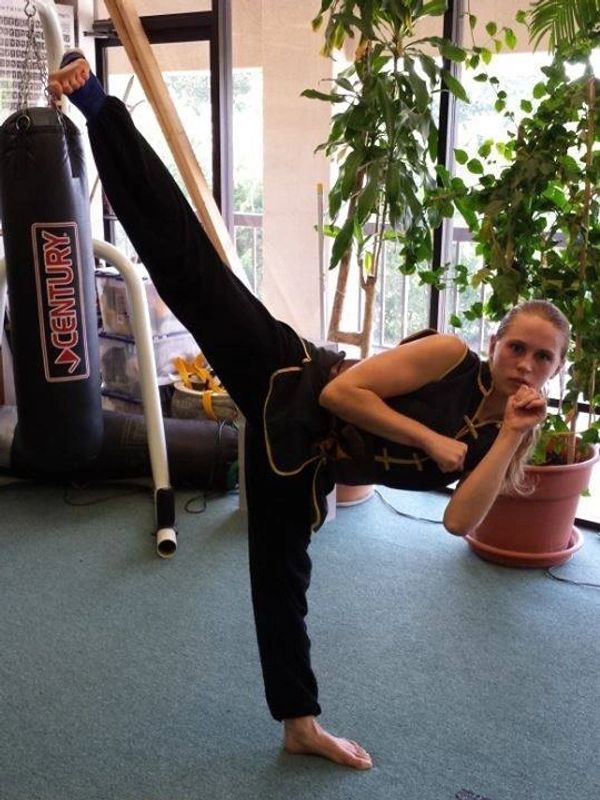
Core Characteristics of the Style
- Strong, rooted stances balanced with agile footwork
- Long-range striking combined with close-range transitions
- Deceptive movement and angle changes (“lost track” footwork)
- A blend of external power and internal control
- Practical applications developed alongside traditional forms
- "Cotton Wrist with an Iron Fist"

My Jhong Law Horn (Mizong Lohan) Kung Fu
Mizong Lohan (spelled My Jhong Law Horn in Cantonese) is the result of an artful blending of two older styles, Mizongquan and Luohanquan, by Shaolin monks in the Song Mountains of H`enan Province, China some 250-350 years ago.
Mizongquan means "lost-track" or "labyrinth" style, and was first developed in Hebei Province several hundred years earlier. Mizong is known for its deceptive footwork, internal-style softness, and tendency to confuse and frustrate opponents.
Luohanquan is a Northern Shaolin style characterized by its external power, deep stances, and straight-line, long-distance attacks.
In Mizong Lohan, the monks attempted to blend the internal softness and sophisticated strategies of Mizongquan with the strength and grandeur of Luohanquan. They succeeded, creating a new style that was uniquely mobile and evasive even as it was solid and powerful, both smart and tough. Mizong Lohan later left the Henan Shaolin temple and became established in Hebei Province to the North, in the town of Chuong Hsien as well as neighboring Nan Pei county.
All modern practitioners of the Mizong Lohan style trace their lineage to Grandmaster Yip Yu Ting (Yeh Chuk-chuan) of Chuong Hsien, who at a young age in the early 20th Century became the Chief of Guards of the All Victory Security Service of the East Gate, a caravan-guarding company in the tumultuous and bandit-infested "Wild West" of Northern China.
Yip's use of his martial arts skills in defending caravans became legendary, and eventually took him far away from his home village. He gradually migrated from Northern China, where he taught the armies of a series of generals, to Shanghai, where he became an Instructor at the prestigious Central Jing Wu Athletic Association, and finally to Hong Kong, where he spent the bulk of his career as a martial arts teacher at the South China Athletic Association.
Grand-masters Raymond Wong (California) followed by, Johnny Lee Kwong Ming (Dallas, Texas) and Chi Hung Marr (Toronto), moved to the USA in 1970s, and are senior disciples of the late Great Grandmaster Yip.
Pictured above: Sifu Eric "Tex" Emert, GM Raymond Wong, GM C. H. Marr GM Johnny Lee, Sifu Eric M. Emert

Traditional Weapons Training
Weapons are an integral part of My Jhong Law Horn Kung Fu and are introduced progressively.
Training may include:
- Saber (dao)
- Staff (gun)
- Spear (qiang)
- Sword (jian)
- 3 Sectional Staff
- Additional traditional Chinese weapons
Weapons practice reinforces timing, distance, coordination, and respect for traditional methods, strengthening overall martial skill.
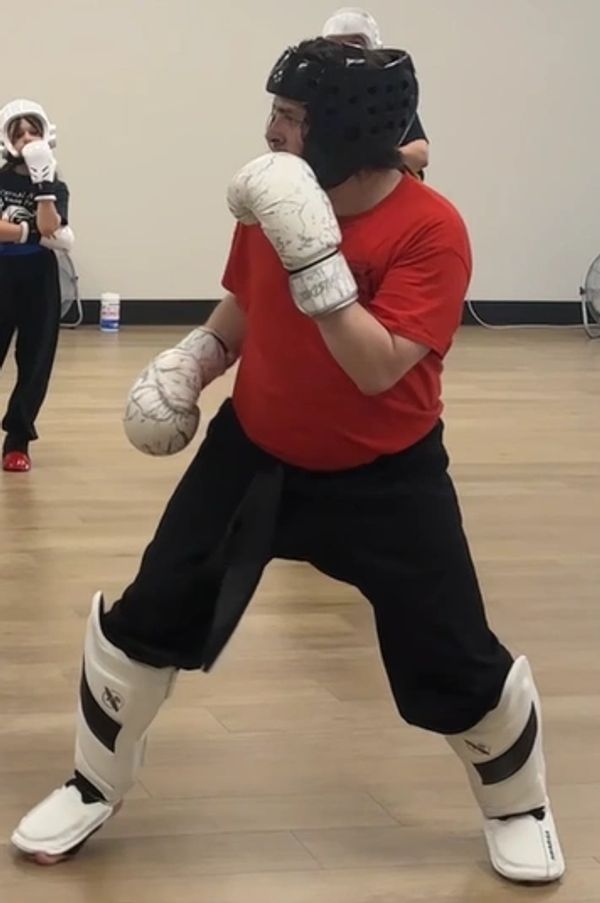
Sparring
Sparring is introduced gradually and safely, only after students develop proper control and fundamentals. Early training focuses on structured partner drills and single-point sparring to build timing and awareness. As students progress, sparring becomes more dynamic under close instructor supervision, always emphasizing control, safety, and respect rather than aggression.

Beyond the Core Curriculum
Mizong Lohan Kung Fu contains over 60 forms, 18 traditional weapons, and countless applications across striking, grappling, and weapons combat.
The structured curriculum, which was developed by Grandmaster Johnny Lee Kwong Ming, not only guides students toward first-degree black belt, but also beyond that point, where the training deepens significantly.
Advanced study focuses on refinement, internal understanding, application, and preserving the art at a higher level.
Pictured above: Grandmaster Johnny Lee throwing Sifu Eric "Tex" Emert

Book a Trial Week!
Well you have made it this far! Stop reading about it! Come try it out!